How do you label offcuts so you can find them again?
Updated
Labelling offcuts means fixing a label to each reusable piece that says what it is and how long it is, with a code that links it to its record, so the next person can identify it without measuring it again. OffcutBench makes these labels free in your browser: record the piece, download its label as a PDF and print it on your own printer.
Free to use. No account, email address or trial. Works offline once prepared.
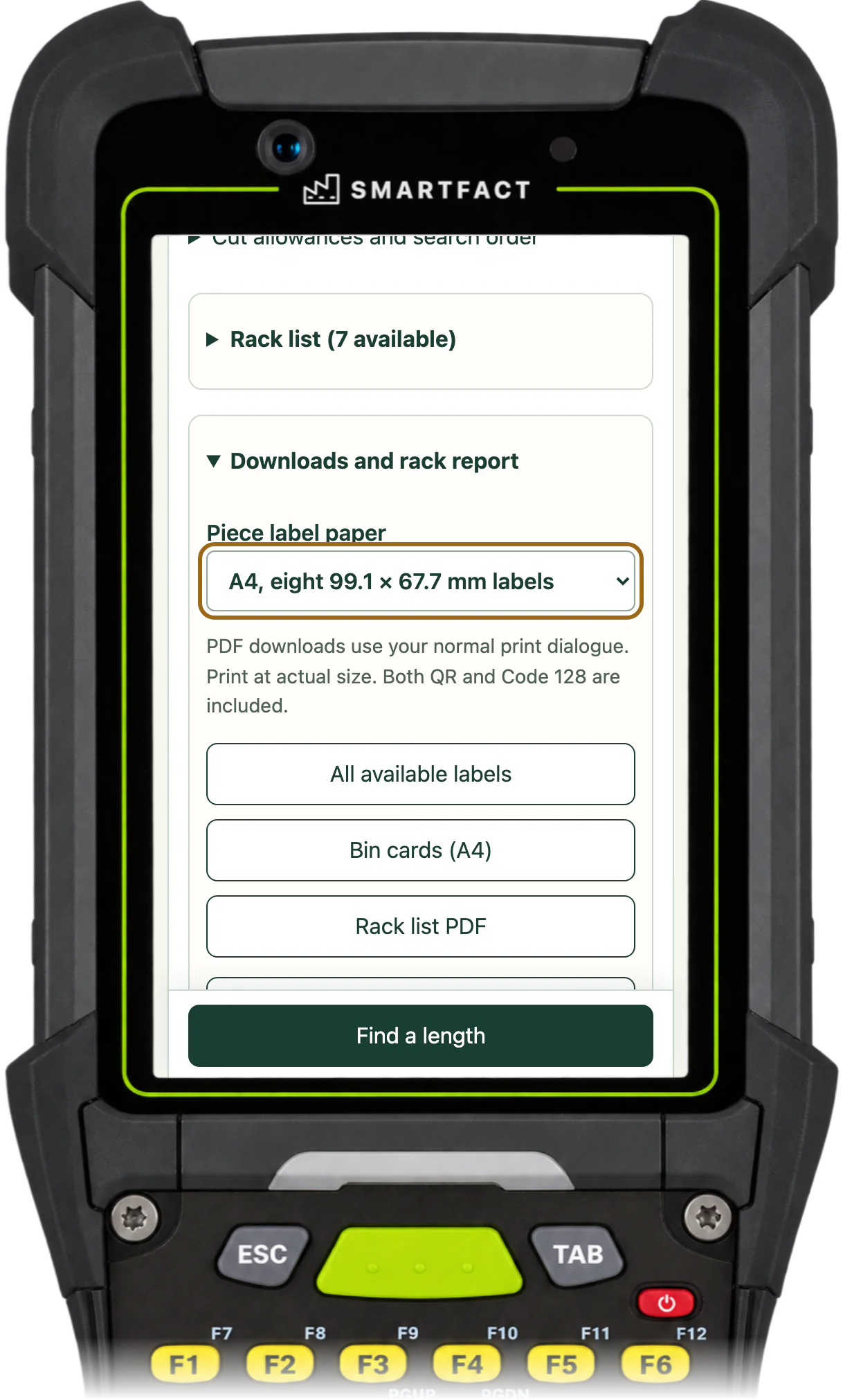
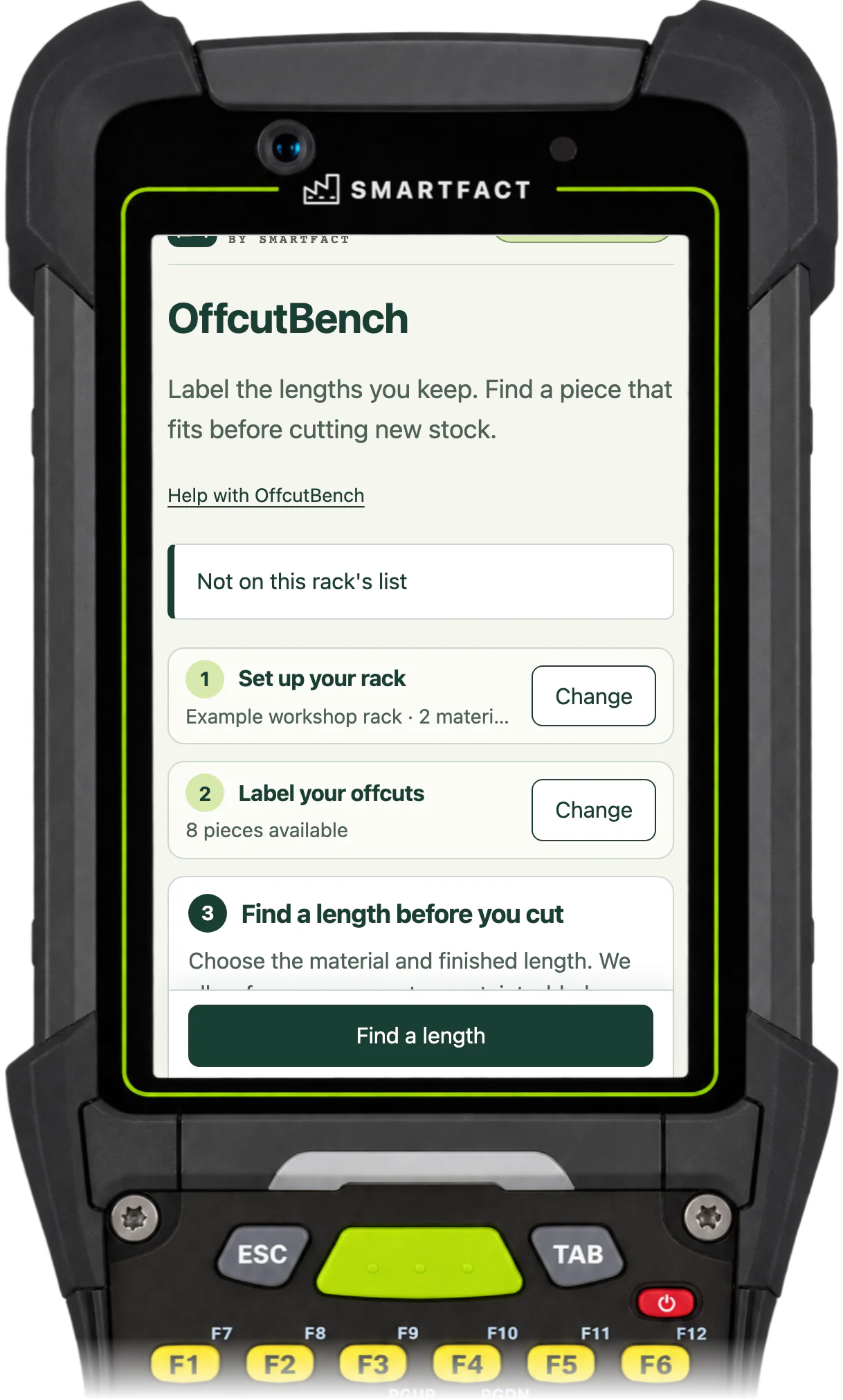
Choosing the label paper before downloading, on a phone, handheld or scan station.
What goes on an offcut label?
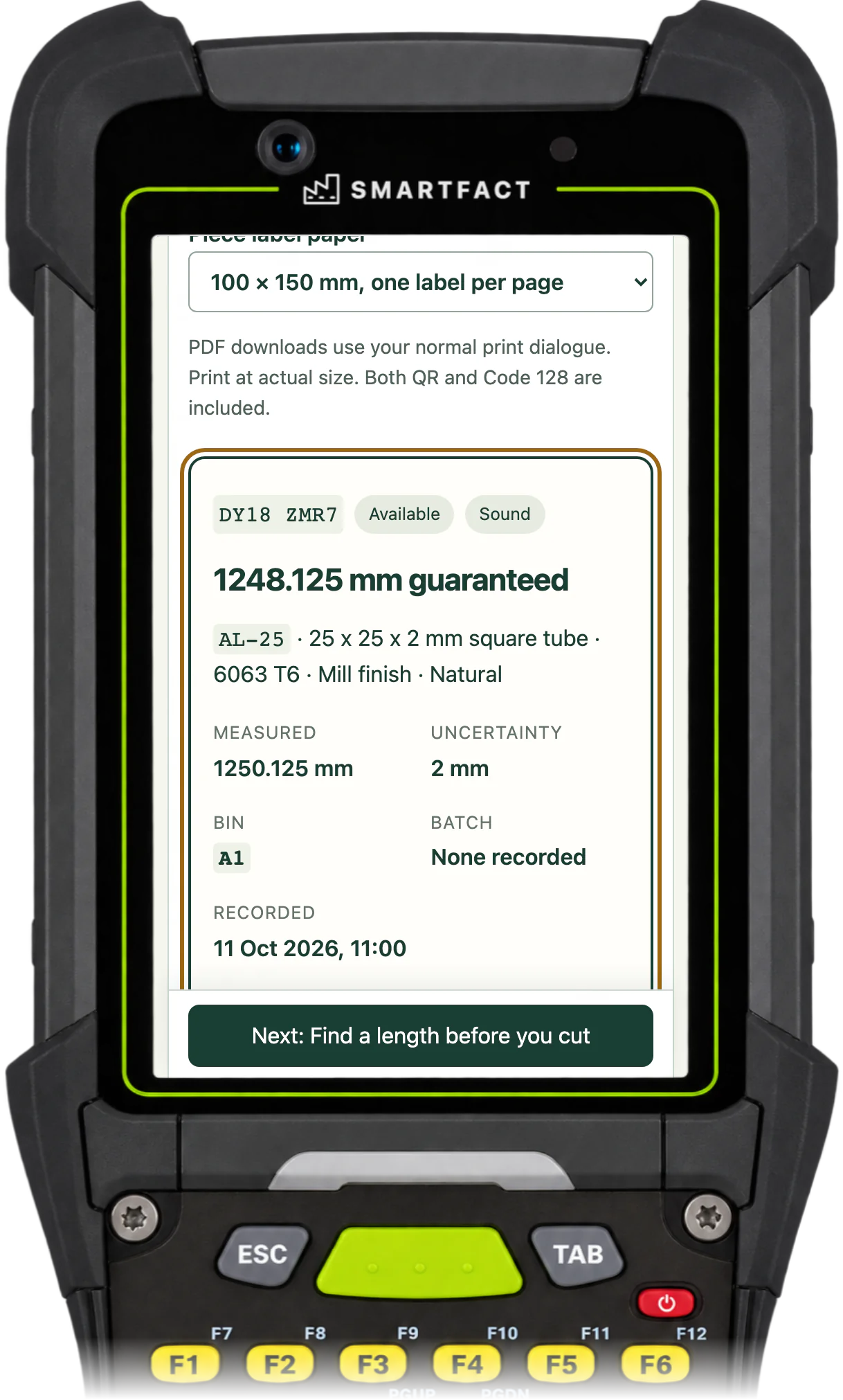
The material code, profile, grade and finish; the guaranteed length, with the measured length and its uncertainty; the condition, batch, rack and bin; and a short reference for the piece. A QR code and a Code 128 barcode carry the same code, which identifies that one piece. Damaged or unchecked pieces are marked Check before use. Text is never cut short: if it does not fit, the download stops with a reason.
The recorded facts that go on the piece's label.
Which label sizes can you print?
A 100 × 150 mm label, one per page, or an A4 sheet of eight 99.1 × 67.7 mm labels. Print at actual size (100%), without fit-to-page scaling, and check one label with your scanner before printing a batch. Labels for a whole rack download in batches of up to 200 pieces.
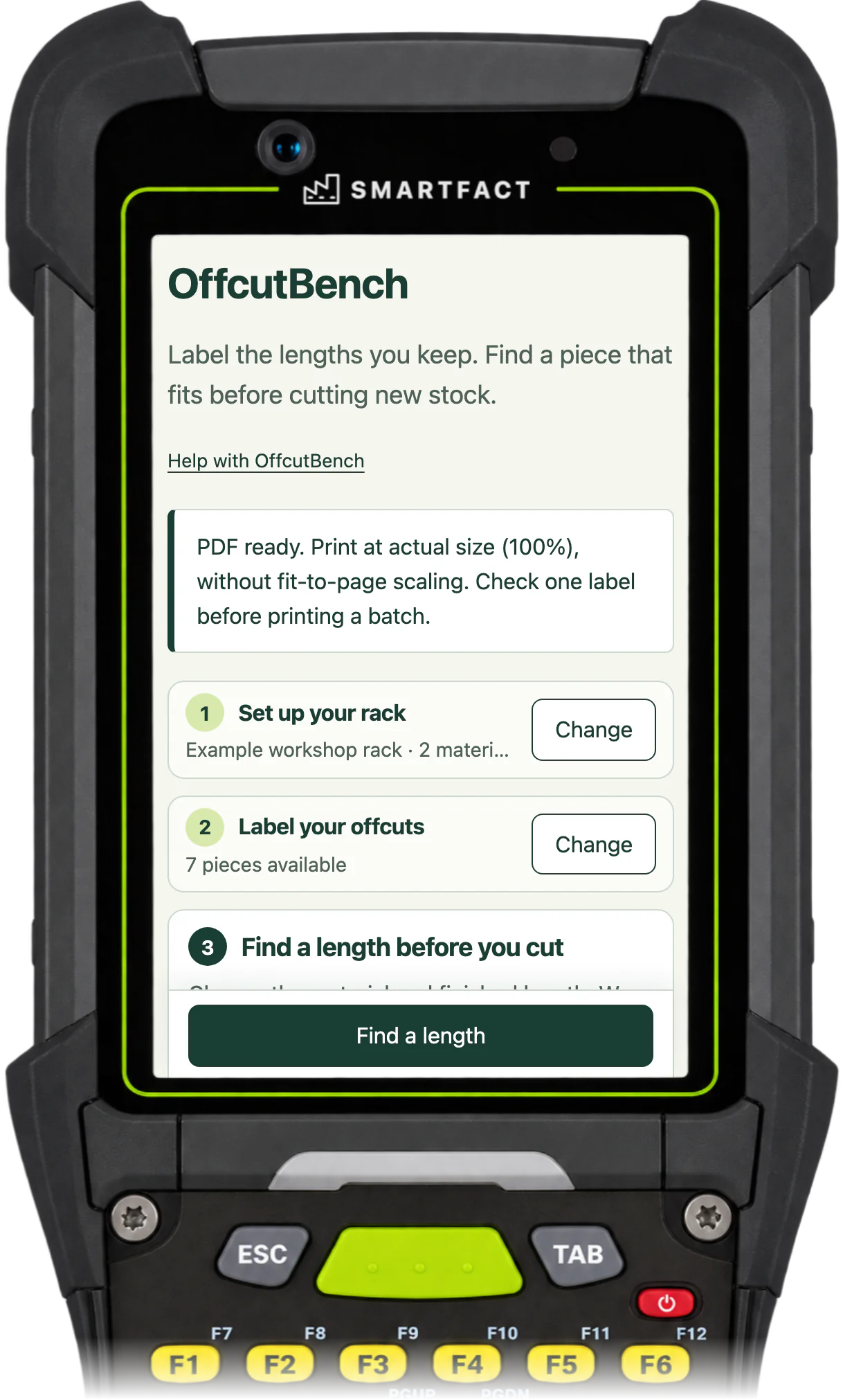
A label PDF ready to print at actual size.
Should bins have labels too?
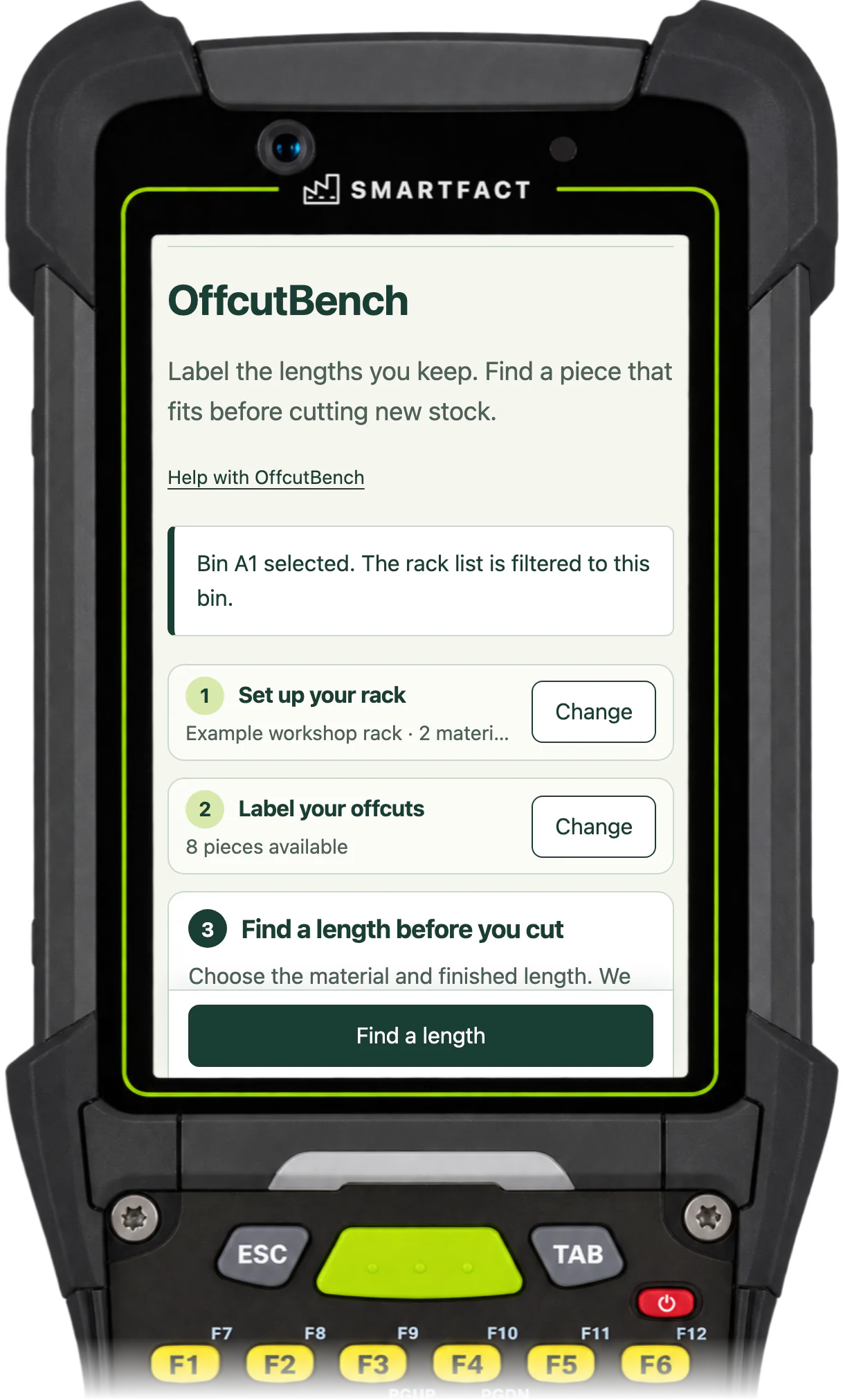
Yes. Bin cards print five to an A4 sheet, each 190 × 52 mm, with the rack code and name, the bin code, the material families it takes and its maximum length. Scanning a bin card filters the rack list to that bin, and selects it for the next piece you record.
A scanned bin card selects its bin.
How do you find a piece from its label?
Scan the label with a keyboard scanner or the device camera, or type its full code. OffcutBench opens that piece from the rack loaded on this device; there is no online lookup. A code that is not on the list says Not on this rack's list.
A label from another rack is not looked up anywhere else.
What happens to the label when a piece is cut?
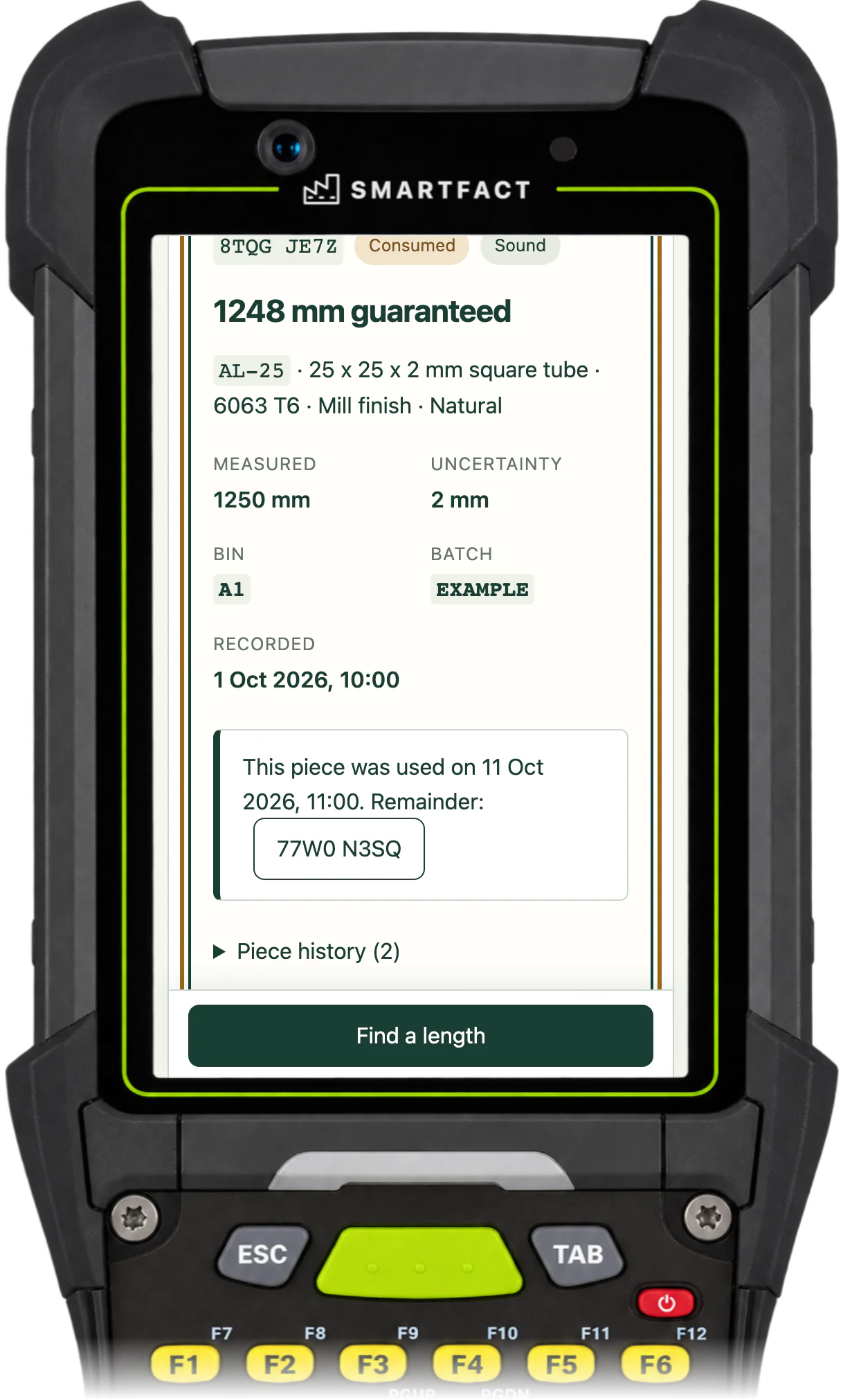
The cut piece is marked as used, and its old label still scans: it shows when the piece was used and the reference of the remainder. The remainder is remeasured and gets a new identifier and a new label, so it never carries the old length.
The old label opens the history and points to the remainder.
What OffcutBench does not do
It makes PDF labels for your own printer. It does not drive a label printer directly or check that a label was printed or attached. Its codes are read only by OffcutBench where your rack is loaded, so they do not replace the labels your supplier or stock system uses.
MADE FOR THE FLOOR
For fabricators, joiners, stores staff and makers who put offcuts back on the rack and want each piece identified without measuring it again.
A USEFUL STARTING POINT
A length in marker pen does not say what is left
Marker on the metal fades, and after one cut the number is wrong. OffcutBench prints each label from the piece's record, with its material, guaranteed length, condition and bin. When the piece is cut, the remainder is remeasured and gets a new label, and the old code opens the history instead of an out-of-date length.
FROM QUESTION TO EVIDENCE
Three steps to a useful result.
01
Record the piece
Measure the offcut, choose its material and bin and record its condition. OffcutBench gives it its own identifier.
02
Download the label
Choose a 100 × 150 mm label or an A4 sheet of eight and download the PDF. Print it at actual size on your own printer.
03
Scan it later
Scan the label with a keyboard scanner or the camera to open the piece, record a cut or check its condition.
A CONCRETE EXAMPLE
The remainder gets a new label
A 1250 mm length of AL-25 tube, 1248 mm guaranteed, is cut into two 600 mm blanks. The remainder measures 34 mm and is recorded with a new identifier and a new label, 32 mm guaranteed. OffcutBench notes that it is below the 100 mm keep threshold, so it can go for scrap instead. Scanning the original label now shows when it was cut and the remainder's reference.
USED IN PRODUCTION
From one rack to the whole workshop.
OffcutBench keeps one person's list for one rack. When several people cut from shared racks, RemnantRack keeps the offcut register for the whole team. It is in early access, with scope agreed at onboarding.
Early access
RemnantRack
RemnantRack gives every reusable offcut a label, an exact length and a confirmed bin across your racks. Search for the length a job needs, reserve the piece so nobody else takes it, record the cut and label the remainder, with team access and a history for every piece.
No. Any printer that prints a PDF at actual size works with A4 sheets of eight labels, and a printer for 100 × 150 mm labels works too. PrintBench checks that your printer reproduces a PDF at the right size.
What is in the barcode?
A code for that one piece, not a web address: OBP1 followed by the piece's identifier. It opens the piece only where that rack is loaded, so a label from another rack shows as Not on this rack's list.
Can I print a label again?
Yes. Open the piece and choose Download this label, or download labels for every available piece. A used or scrapped piece's label cannot be downloaded again.
What are the current limits?
OffcutBench is one person's list for one rack of straight lengths, such as bar, tube, extrusion, profile or timber. There are no sheets or irregular shapes, no nesting or cutting optimisation, no reservations, no shared team stock and no saw control, and a search never reserves or changes a piece. Each search looks for one piece long enough for the whole job. A project holds one rack with up to 100 bins, 500 materials, 2,000 available pieces and 20,000 history records, in a saved file of at most 5 MiB. Lengths run from 1 mm to 60 m. The unit is fixed when the rack is created, and the usual measuring uncertainty is fixed once the first piece is recorded. CSV imports are up to 5 MiB, and one invalid row stops the whole import. The camera reads QR, Code 128, Data Matrix, EAN and UPC barcodes. Labels and reports show what you recorded, not proof that a piece is on the rack.
What happens to my data?
Your rack stays in this browser. Work starts in memory and is lost on refresh until you choose Save on this device or download a backup. Nothing you record, scan or download is uploaded, and camera images are decoded on your device and never stored. No account or contact details are needed. Google Analytics is optional and loads only after you accept; it never receives materials, lengths, label codes, job references or file contents. Use Analytics settings on these pages or in the tool to change your choice; see /privacy/.
ONE SMALL JOB, DONE WELL
Put OffcutBench to work.
Open the free tool and start with one known example.
Practical tools. Useful on their own. Better around the same floor.
Automate factory decisions with rules you describe in plain English. Explore focused SmartFACT services, plus free tools for everyday checks.
Early accessSuggested next step
RemnantRack
Label each offcut, find a suitable length before cutting new stock and record what you used. Approved plain English rules decide what to keep and where it goes.
Bring data in from uploaded sheets or the Shopify, WooCommerce and PrestaShop connectors, check each change and deliver it to the products that use it.
Scan an empty container to send the right refill request to stores. Approved plain English rules set the stores queue, priority, ticket printer and escalation.
Check a shared tool before handover, record who has it and keep damaged or overdue tools out of the next issue. Explore an invited trial for one factory crib.
Receive, put away, reserve and issue stores material with barcode checks, keeping held, reserved and available stock apart. Explore an invited trial for one stockroom.
Follow a lot or serial number through the records your factory already keeps, with the source of each link and the gaps shown. Explore an invited trial with two declared sources.
Step-by-step guides and interactive demonstrations for the SmartFACT suite. Read the instructions, watch a task or practise with real product screens and sample data.

 Early access


